State v. Dade and Implied Consent Pretrial Motions Chart
For implied consent offenses, pretrial motions to suppress evidence and/or dismiss the case must be made pretrial, according to and in accordance with G.S. 20-38.6. Broadly speaking, this requires the district court judge to preliminarily indicate how they would rule and then provides an avenue for superior court review of their preliminary indication. The procedure for these pretrial motions is not always clear. Sometimes the judge can go ahead and enter final judgment as an order immediately following the motion, and sometimes they cannot. Sometimes they can rule summarily without a written order, and sometimes they cannot. Last month the Court of Appeals gave us some more guidance on the statute’s requirements and their significance in State v. Dade. Read on for a primer on pretrial motions procedures, a new chart, and the latest from the Court of Appeals.
Background. G.S. 20-38.6 sets out the procedure for pretrial motions in implied consent offenses. I’ve created a flow chart for a different way of viewing the requirements. This chart addresses the required procedure from the perspective of the district court judge (DCJ) and covers motions to suppress (MTS) and motions to dismiss (MTD).
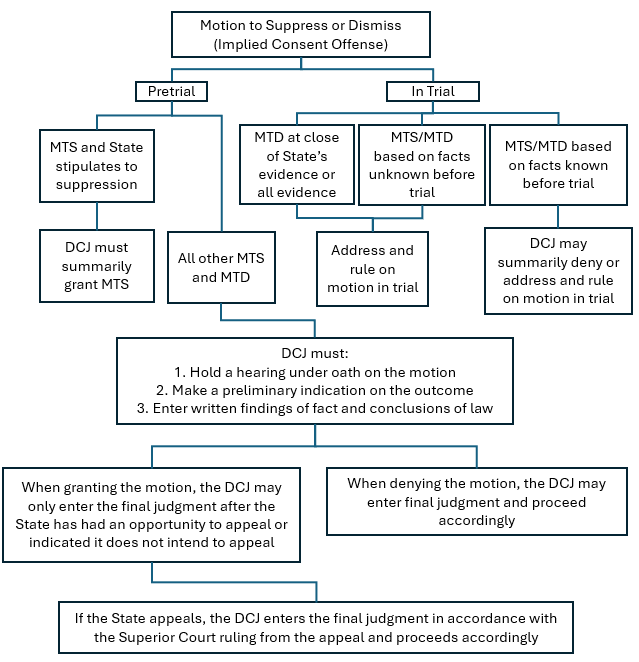
Superior court. The role of the superior court is set out in G.S. 20-38.7. If the State appeals a preliminary indication granting a motion to suppress or dismiss, the review by the superior court is guided by whether there is a dispute about the findings of fact. If there is a dispute about the findings of fact, the superior court determines the matter de novo. This is often accomplished by holding a hearing and accepting evidence much in the same way the motion was litigated in district court. If there is no dispute about the findings of fact, the superior court reviews the written findings and conclusions of law and determines whether the conclusions of law are supported by the facts. In either circumstance, without ruling on the motion, the superior court makes findings on the correctness (or incorrectness) of the preliminary determination, and remands the matter for the district court to enter a final judgment accordingly.
Caselaw developments. While instructive, the statutes do not include a high level of detail. The Court of Appeals has since interpreted and applied the statutes, giving us more guidance. My colleague Shea Denning has written extensively on these developments to date:
- State v. Woolard: DWI, Probable Cause, and Motions Procedures (2024)
- State v. Miller Confirms that the DWI Motions Statutes are a Hot Mess (2016)
- More About Those Weird DWI Motions Procedures (2015)
- State v. Osterhoudt and motions procedures in implied consent cases (2012)
- DWI Appeal Procedures: Fowler and Palmer (2009)
State v. Dade. In the latest case addressing pretrial implied consent motions, the defendant was charged with driving while impaired after an officer observed erratic driving, signs of intoxication, and later obtained a blood test showing a 0.12 BAC. In district court, the defendant moved to suppress, and the court verbally indicated it would grant the motion after finding no probable cause to arrest. However, the court did not enter the written preliminary determination required by G.S. 20 38.6(f). The State filed notice of appeal to superior court, which conducted a de novo hearing, found probable cause, and remanded for denial of the suppression motion. The defendant later pled guilty pursuant to an agreement preserving his right to appeal the suppression ruling.
Pretrial motion procedure. The Court of Appeals held that superior court lacked subject matter jurisdiction to hear the State’s appeal. The Court emphasized that the State’s right to appeal in criminal cases is purely statutory and must be strictly construed. Under G.S. 20 38.6(f), a written preliminary determination is a prerequisite to the State’s appeal. Because the State appealed the verbal ruling alone, the appeal was improper and could not confer jurisdiction to superior court. As a result, the superior court’s de novo hearing and order were void, and the Court of Appeals vacated the order.
The consequences. Turning to plea, the Court concluded it must be rescinded. The plea agreement expressly preserved the defendant’s right to appeal the denial of his suppression motion, but no such appeal right existed because no valid final order had been entered. The Court reasoned that the plea was entered in detrimental reliance on a material misunderstanding. Applying contract principles governing plea agreements, the Court rescinded the plea and remanded to the district court to enter a written order pursuant to G.S. 20-38.6.
A final note on appellate procedure. This was almost the case that never was. As described above, a superior court’s order instructing the district court on how to rule is not a ruling on the motion to suppress and is not a final judgment. G.S. 15A-979(b) establishes that an order “finally denying” a motion to suppress may be reviewed upon an appeal. Further, the Court cited State v. Hutton, 244 N.C. App. 128 (2015), in which appellate review was barred due to the lack of a final order denying the motion to suppress. In Dade, the Court found that the same bar to appellate review applies and would deny the Court the ability to review the proceedings – except the defendant also petitioned for Writ of Certiorari. In determining whether to grant certiorari, the Court noted four cases where it did so in similar circumstances with pretrial implied consent motions (State v. Osterhoudt, 222 N.C. App. 620 (2012); State v. Palmer, 197 N.C. App. 201 (2009); Fowler, 197 N.C. App. 1 (2009); and State v. Via, 197 N.C. App. 398 (2009)). The Court found that where the bar to appellate review was due to the district court’s error and could lead to a violation of the defendant’s fundamental rights, granting certiorari was proper.
We will continue to watch statutory and caselaw updates closely as the law develops. As always, feel free to reach out to me with any questions or comments. I can be reached at elrahal@sog.unc.edu.