
Technical Assistance and the UNC EFC – A Different Approach
By Hope Thomson, Project Director, SOG Environmental Finance Center
The School of Government Environmental Finance Center (SOG EFC) was founded in the late 1990s to support the financial sustainability of entities providing environmental services. Though the SOG EFC’s work has varied over the decades, direct technical assistance and advising to communities, specifically regarding water and wastewater utilities, has long been a core component of the Center’s focus. Housed in UNC-Chapel Hill’s School of Government, which also provides training opportunities and direct advising to North Carolina government units, the SOG EFC has provided technical assistance (TA) throughout North Carolina and the Southeast.
A History of Technical Assistance
Historically, technical assistance at the SOG EFC could take many shapes and forms but included two key components. First, TA was usually requested directly by a community. Second, the SOG EFC’s support was typically provided free of charge as part of an existing funder’s program. Sometimes, the funder placed restrictions on which utilities may receive TA. For example, the SOG EFC’s TA support was provided as part of US EPA grant programs designed to build capacity at small water systems (i.e., serving 10,000 or fewer individuals) or small wastewater systems (i.e., processing less than 1 million gallons per day). At other times, TA was tied to a specific topic area – for instance, the SOG EFC is currently engaged with several communities that operate independently but are considering regional service models.
Regardless of how the TA was funded, aiding the community contained consistent elements. The SOG EFC used a variety of data-based tools developed in-house to assess financial conditions and make recommendations to improve long-term financial sustainability. This may have consisted of running a Financial Health Check Up to see the trends of key performance indicators over the most recent five years. Often, the SOG EFC helped utilities to reassess their rate structures, especially if they hadn’t altered their rates in a long period of time or if they hadn’t differentiated between customer classes (e.g., residential, commercial, industrial) within their service area. The SOG EFC may have advised on regionalization efforts, the development of interlocal agreements, or best practices for affordability. Finally, the SOG EFC may have presented analyses to decision-making bodies to provide a more objective 3rd party perspective on financial challenges and potential solutions.
H20 Community Solutions Team Pilot Program
In 2022, the SOG EFC embarked on a pilot project funded by the US Environmental Protection Agency (EPA) called H2O Community Solutions Team (CST). This project focused on assessing and assisting struggling utilities with preparing to apply for State Revolving Fund (SRF) dollars to support infrastructure projects.
The SOG EFC team worked with the US Water Alliance (USWA) and the Water Resources Research Institute at Mississippi State University (MSU) to bring a multipronged approach to this new kind of TA. While the SOGEFC has extensive experience with utility financial management, MSU provided insight into technical problems, and the USWA brought a community engagement lens to the work. The TA provided through CST focused on identifying capital improvement projects that could be covered through an SRF loan application and financial strategies for covering debt payments and ensuring financial sustainability. However, the TA often went a step further – beyond utility staff and local elected officials. Through community listening sessions, the broader population was invited to share their experiences, concerns, and priorities for the water and wastewater services in their community. At the same time, the TA team and the utility could share with the customers the challenges existing in the infrastructure, the potential plan for SRF applications, and any additional expected changes. The goal of this extended dialogue between community members, staff, decision-makers, and subject matter experts, such as the TA team, was that it would not only generate SRF applications but also improve communication and understanding between the utility and its customers moving forward.
A “Water Infrastructure” EFC
Though the CST pilot has concluded, the SOG EFC continues to practice this “new” kind of TA. As an EPA Region 4 water infrastructure EFC, the SOG EFC will assist communities in accessing infrastructure dollars made available by the Infrastructure Investment and Jobs Act (IIJA). A significant portion of IIJA dollars is flowing through SRF programs. These programs can fund traditional infrastructure projects. With the additional IIJA funds, they can also fund lead service line work and projects that address emerging contaminants, such as per- and polyfluoroalkyl substances (PFAS). The SOG EFC has additional resources to understand IIJA and the implications for funding availability.
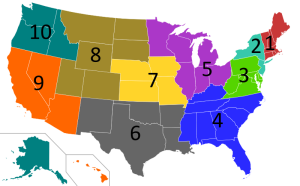
Figure 1: EPA Regions
The SOG EFC can assist communities with accessing SRF funds in Region 4 via analysis of financial preparedness for additional debt service, spatial analysis, assessment of potential for principal forgiveness, community engagement strategies, and other assistance as necessary.
The IIJA-related work in Region 4 certainly relies on the tools and expertise that the SOG EFC has honed over time — but it differs in a few essential ways. Assistance via this program targets accessing SRF funds for water or wastewater system improvements. Secondly, the relationship between the community and the SOG EFC as their technical assistance provider is similar to that of CST – it is often much more involved than previous TA, with collaboration happening over longer periods of time and moving through various phases (i.e., time to meet with community members, assess infrastructure needs, determine funding capacity and prepare a funding application). Finally, through these technical assistance collaborations, the SOG EFC is exploring new mechanisms of assistance. Whether by creating a network of external resources or training staff on new skills, tools, and processes to better support communities seeking infrastructure improvements, the SOG EFC’s new foray into technical assistance is an opportunity to become a better partner to the communities the center serves.
In total, this technical assistance is a more holistic approach to community support. SOG EFC staff strive to meet communities where they are and work to connect them to resources they need to address water and wastewater infrastructure needs. This bespoke approach is unlike TA the SOG EFC has provided in the past and is centered around consideration of comprehensive community needs.
If your community has water, wastewater, or stormwater needs, is interested in applying for SRF funds, or just learning more about SRF funding options and is in EPA Region 4, the SOG EFC might be able to help. Please visit the link below for more information or to request technical assistance.
Need technical assistance? The UNC Environmental Finance Center is here to help!
The School of Government Environmental Finance Center offers free one-on-one technical assistance for small water systems. If you have an interest in our support, fill out our Technical Assistance Request Form, or contact us at efc@sog.unc.edu.