
Mission Moment: Julie Beasley Helps Connect Older North Carolinians with their Local Governments
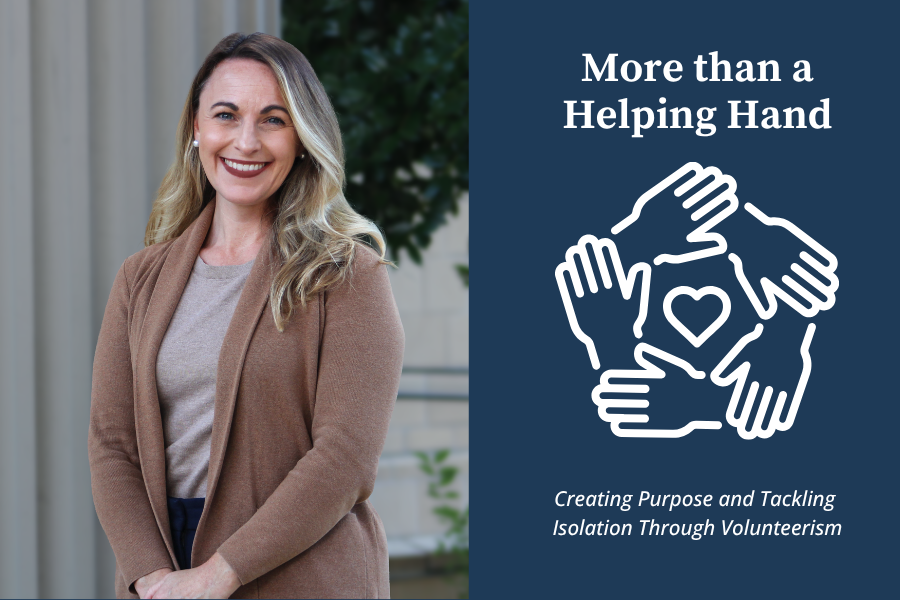
In North Carolina, 26.8 percent of older adults live alone, with 1 in 4 globally experiencing isolation, and 1 in 10 dealing with the effects of depression caused by isolation. Left unaddressed, that isolation frequently leads to heart disease, anxiety, and dementia, along with other severe, life-altering health consequences. Their families have grown up, and old friendship circles are beginning to dwindle. What waits for them in this new season of life?
School of Government faculty member Julie Beasley and her team are giving local governments new tools to tackle senior isolation.This fall they launched the “More Than a Helping Hand” pilot project, thanks in great part to support from the School of Government, the ncIMPACT Initiative, and Civic Federal Credit Union.
“The initial phase of the project is being launched in a three-county area, and we hope to have an impact and find a positive link between volunteering and perceptions of health and wellness outcomes such as anxiety, depression, social isolation, and self-efficacy,” said Beasley.
She is working with Lisa Herrera in the Department of Psychiatry in the UNC School of Medicine and Leopolda Santana with NC State University. The pilot currently serves Durham, Orange, and Chatham counties. Herrera, who connected with Beasley at UNC's Faculty Development seminar, speaks to the heart of the collaboration."Gratitude and hope are the words that summarize what the purpose and goals are for the 'More Than a Helping Hand' project. This project resonates with us on a personal and professional scale as we acknowledge how life changes can lead to social isolation and difficulty finding meaning.”
Beasley’s road to “More than a Helping Hand” began before her time with the School of Government, or even in North Carolina. Beasley worked as a project manager at the Observing Civic Engagement Lab during her doctoral studies at Indiana University, a role that significantly influenced her current project.In that position, Beasley studied various ways that strengthening civic engagement impacted local communities. Social engagement is a key tool to mitigate isolation and loneliness.
“More than a Helping Hand” engages older populations through volunteer opportunities, with the intention of reducing their risk of social isolation.“We hope to have a dual impact through changing the lives of participants and providing support for communities,” said Beasley. “The goal is to help foster cross-sector connections to develop sustainable programs alongside citizens who contribute time, skills, and expertise to local nonprofit organizations that are also seeking to provide services and transform communities.”
Josh Davis, a current student in the School’s Master of Public Administration program, was assigned to Beasley’s team as her research assistant early in 2025.“One of the things that has made my experience in the UNC MPA program so valuable is how our faculty connect both research and theory to practice,” said Davis. “It is especially meaningful to be a part of research that addresses challenges facing communities that will have a lasting impact on older adults across North Carolina.” Davis has taken an active role since the project's conception.
For the pilot program’s first year to be successful, the team at “More than a Helping Hand” works hard to integrate the 55+ community into local volunteer opportunities. Davis expressed eagerness to continue an active role and to make the connections between local governments and nonprofits necessary for this project to thrive.
The future of the project is hopeful but uncertain. The pilot is twelve months long, with six months dedicated to data collection and focus groups. Beasley is looking for an opportunity to extend it. “Our research team has long-term aspirations to develop this into a multi-year project, expanding into more rural areas and reaching isolated communities across North Carolina.”
Connecting seniors with nonprofits, adding community resources, and securing additional outside funding will be paramount to meeting that goal, particularly as the project looks to grow beyond its current three-county footprint into rural communities where resources are often fewer and farther between.“Ideally, I’d love to see this project expand each year, with an annual event bringing volunteers together with the support of the School of Government and the School of Medicine,” stated Beasley.
This project reflects not just Beasley's research, but her life's work. "I, personally, have a heart for leadership and service, having spent many years volunteering and serving on boards. I am excited to inspire our older adult population—who have so much wisdom and compassion to share—to connect with organizations that align their passions and realize the public value they contribute through strengthening organizational and community capacity.”
“Our aim is to provide networks of support to local government departments on aging, senior centers, regional councils, and nonprofit organizations—while positively influencing the health and wellness of our aging population. It’s a multi-generational movement requiring the collaboration of the public, private, and nonprofit sectors,” said Beasley. “I am eager to see this project come to life and hear stories of lives that are changed in ways that meet the vision of the School’s founder, Albert Coates.”
"At the end of the day, the School of Government is all about improving the lives of North Carolinians, helping public officials and everyday citizens get a better handle on how state and local government works and how to make it better. That's exactly what this project is trying to do."
Get involved with “More Than a Helping Hand” through their website: https://morethanahelpinghand.sog.unc.edu/
This has been a Mission Moment
In 2026, marking our 95th anniversary, we're launching "Mission Moment," a story series spotlighting faculty whose work brings that mission to life—not abstract policy stories, but stories about people showing up, building trust, and making government work better for everyone.
Published September 25th, 2026