
Parking Lots and Opportunity: The Development Finance Initiative Helps Local Officials Bring Affordable Housing to Downtown Durham
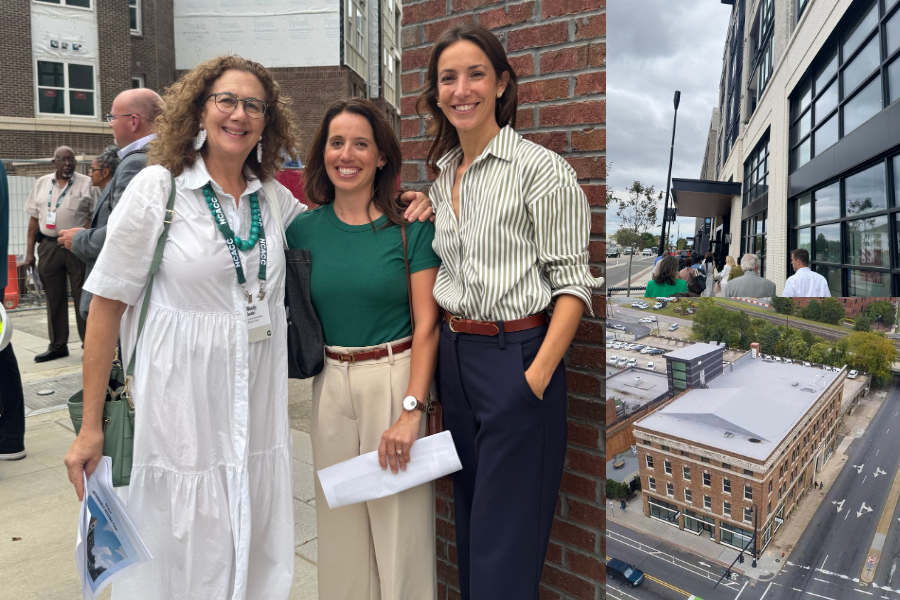
Two parking lots next to Durham County government buildings had long sat underused. When rapid development and growth in downtown Durham raised concerns about displacement for long-time residents, County Commissioner Wendy Jacobs saw an opening. Durham County partnered with the UNC School of Government's Development Finance Initiative (DFI) to assess what those lots could become, and after two years of planning, a path began to take shape. The result of their combined efforts is a plan to convert the parking lots into developments with305 affordable and 248 market-rate apartments, plus childcare facilities and retail on East Main Street.
On a recent tour of the site, Director Marcia Perritt and Associate DirectorSarah Odio walked us through the details of how that partnership came together. "Durham County has been a DFI partner since 2017, when we started working together on the 300 and 500 East Main sites. We've continued to work side by side on other projects since," offered Perritt.
The team at DFI provided a pre-development financial analysis and helped connect local partners with Durham County leaders. This helped officials identify financially possible projects that also met the needs of the community. “Our analysis found that of the 13,450 new multifamily units built in Durham since 2020, only 6 percent were income-restricted. The market alone isn't producing housing for the people who keep the Durham community running, including teachers, first responders, and county employees. Local governments like Durham County are leading by leveraging their own land and resources," said Odio.
County staff also consulted with multiple School of Government faculty to review the legal authority and complex deal structure required for the project, including unique procurement requirements, property tax implications related to long-term leases, authority for downtown public-private partnerships, and joining of the county's housing, redevelopment, and local development powers.
The county broke ground in 2022 at 300 East Main Street after a competitive process facilitated by DFI, and two private developers were selected to build those projects. ZOM Living and Laurel Street Residential created 110 units across three floors, along with ground-floor space for retail and pre-K childcare. The units are mixed-income, meaning they are available for purchase by households of varying incomes, ranging from 30 to 60 to 80 percent of the area’s median income. To protect that affordability structure in the long term, plans are in place for rights of first refusal, ensuring Durham County has the opportunity to step in if the properties are ever considered for sale.
This extends to the second location at 500 East Main as well. 500 East Main is a mixed-income community; the front building houses market-priced luxury apartments with enough space for retail possibility on the ground floor and 200 units of affordable housing on the back end. It is worth noting that Durham County's involvement is limited strictly to the affordable housing portions of these developments. The retail and commercial spaces operate independently of any public funding or oversight. As of August 2026, the affordable housing units were not finished but structurally sound, with the promise of updated fixtures just like the original build on 300 East Main.
"The East Main projects alone are delivering 305 homes affordable to households earning 30 to 80 percent of the area median income, while also transforming a part of downtown Durham that hasn't seen much private investment," said Odio.
The East Main Street project is not a quick fix. From the first partnership in 2017 to the expected completion of 500 East Main, the full vision will have taken nearly a decade to realize—a reminder that meaningful community development moves at the pace of trust, planning, and persistence.
For DFI, that process is the highlight of the job. "Development pressure in Durham isn't letting up, and county leaders face tough decisions related to how to use public land and public dollars to meet community goals. Our job is to stand beside them through those choices, grounding the community's vision in market and financial realities so it can become projects that get built," said Perritt.
It is exactly the kind of work the Development Finance Initiative was built for.
For more information on the Development Finance Initiative, please visit https://dfi.sog.unc.edu/about/
Photographed left to right: Durham County Commissioner Wendy Jacobs, Director Marcia Perritt, Associate Director Sarah Odio
Overhead photo of 300 E. Main courtesy of Zillow
Published October 19, 2026