
Service to Country, Sharpened by Education
Few people can say they’re skilled helicopter pilots. Fewer still can say they’ve carried out high-stakes search-and-rescue missions—or coordinated them.
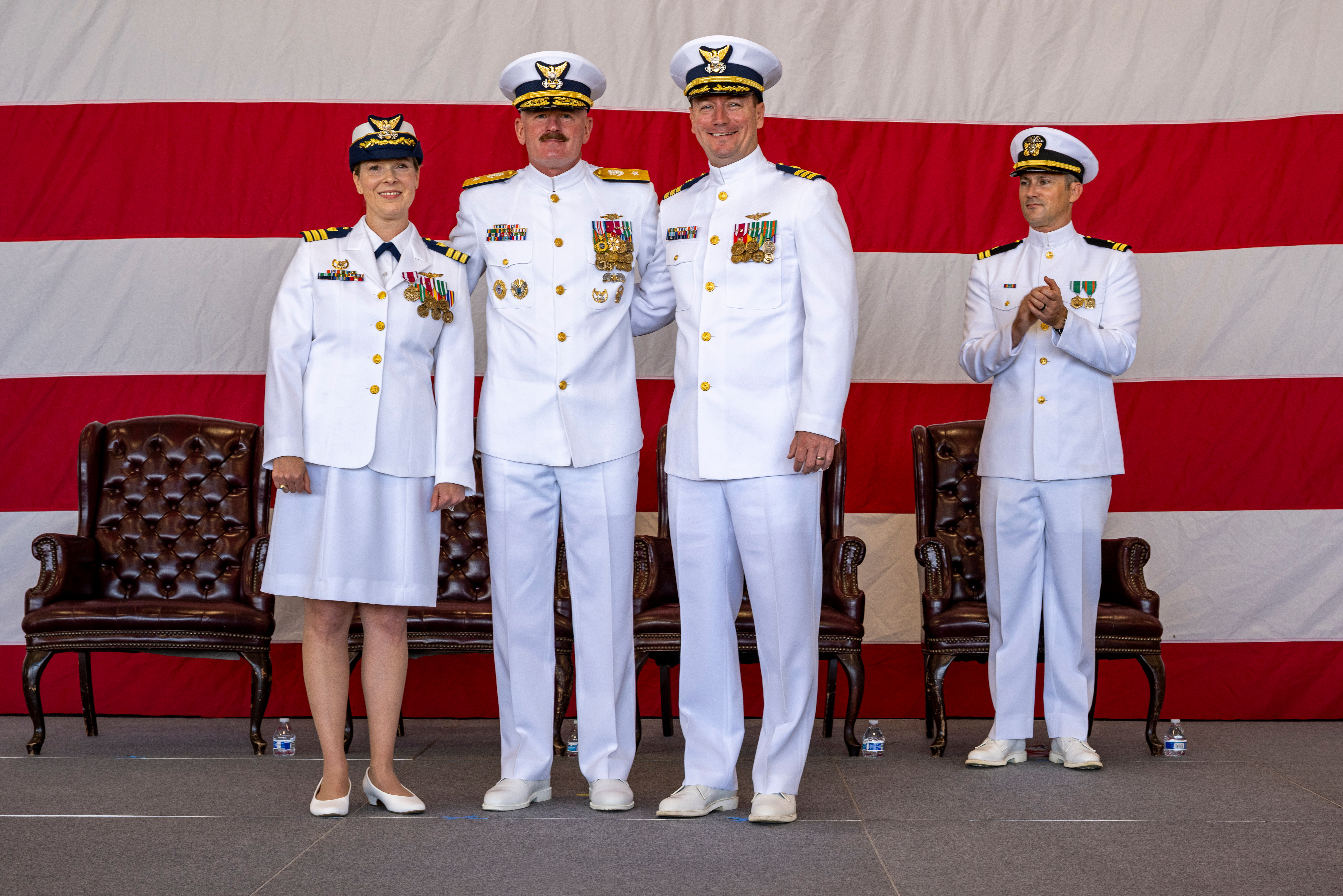
Greg Waugh (MPA ’22) can say all of that. And on August 14, 2026, he added another accomplishment: taking command of U.S. Coast Guard Air Station Ventura.
His Coast Guard career gave him the technical skills and experience the role requires. But Commander Waugh credits UNC’s MPA program with giving him the organizational and leadership capabilities to meet the demands of a senior Coast Guard command position.
From Pilot to Leader
At 12, Waugh set his sights on becoming a pilot. “I remember seeing airplanes and helicopters flying around and decided that was something I wanted to do,” he recalled.
As an undergraduate at the Coast Guard Academy, he “fell in love with the Coast Guard’s missions,” he said. Once he graduated, he was commissioned as an officer. Two years later, he trained as a helicopter pilot, which qualified to fly search and rescue missions.
Waugh continued moving up the ranks, with a four-year stint on a counter-narcotics squadron, a role as executive assistant to an admiral, and later positions as operations officer and chief pilot at the Coast Guard’s San Diego air station.
As he advanced, Waugh knew he wanted to broaden his expertise beyond aviation, but to do that, he needed a graduate degree. While some of his peers pursued an MBA or an advanced engineering degree, an MPA was the clear choice for Waugh. “I knew it would apply both to my Coast Guard career as well as my potential future in government or nonprofit sectors.”
Choosing UNC
For Waugh, coming to UNC was a no-brainer. The university’s reputation was a draw, as was the fact that UNC was “clearly a military-friendly school,” he said. When researching his options, UNC also made clear that his tuition would be fully covered under the GI Bill.
UNC’s MPA program stood out for another reason: It was one of the few virtual programs with a live component. “I actually wanted to meet and connect with my cohort. With many programs, you write a check, submit some assignments, and you get a degree, but I was looking for more than that.”
More Than a Degree
UNC gave Waugh everything he came for—and more, including the flexibility to continue serving the military. “Occasionally I had to miss a class or needed to extend a deadline due to the Coast Guard, and everyone was super understanding and supportive of that.”
Just as importantly, multi-day on-campus intensives gave him the connection he had been looking for. During visits to Chapel Hill, Waugh met faculty members, heard guest lectures, and bonded with classmates outside the classroom—including over Coach K’s last regular-season Duke game, which he and members of his cohort watched together on Franklin Street. Those experiences deepened both his connection to the program and his commitment to public service.
Landon Lynch (MPA ’22), a Coast Guard Employee and Labor and Employee Relations Specialist and a classmate and friend of Waugh sees that commitment in Waugh’s career. At a challenging moment for public servants, Lynch said, Waugh has shown “the adaptability and the steadfast nature to stay and to want to rise and to want to be a leader.”
The relationships Waugh formed at UNC have also lasted well beyond graduation. He remains part of a group chat with classmates working across a range of industries, including Lynch, where they regularly turn to one another for professional advice and support.
Building the Skills to Lead
Courses in professional communication and mediation helped him speak and write more effectively, navigate conflict, and empower others. “I developed the skills to help people resolve their differences and move forward without having to file formal complaints,” he said.
The program also changed the way Waugh thinks about leadership. “Giving people, especially the younger generation, an opportunity to speak their mind, can create opportunities for growth.” Recalling a time when one of his direct reports shared his perspective on a challenging situation, Waugh said, “it was almost like a light switch. Now he’s performing at a high level.”
Meanwhile, the data analysis skills Waugh honed in the MPA sharpened his ability to leverage metrics to better serve the Coast Guard’s objectives. “As a senior officer I may need X, Y, or Z, for my air station. Being able to use data to explain the ‘why’ to senior leadership is a huge asset.”
Taking Command
Waugh was appointed to lead Air Station Ventura earlier this year by the Commander of the U.S. Coast Guard’s Southwest District (covering California, Arizona, Nevada). Now, Waugh is responsible for the entire operation.
As air station commander, Waugh’s responsibilities are vast. His previous roles centered on carrying out search-and-rescue missions and, later, directing them.
“I’m responsible for the entire air station: three helicopters, 120 people, a $1.5 million budget,” said Waugh. “If things go south, the questions will be asked not of individuals but of the commanding officer.”
While Waugh acknowledges the pressures of the position, he relishes the opportunity to serve the members under his command. “It’s on me to give my team everything they need to complete their mission, plus the resources to advance their careers and take care of themselves and their families.”
Ultimately, Waugh hopes to create a culture where his team can see and pursue their own paths to leadership. “I want people, particularly the pilots, to want my job in the future,” said Waugh. “I want the ‘coasties’ under me to succeed. I want to promote a culture where they can achieve their personal and professional goals.”
Photographed above from left to right: Commander Amanda G. Sardone, Rear Admiral Jeffery W. Novak, Commander Gregory C. Waugh
Published September 9th, 2026