
Serving with Purpose: New Faculty Reflect on Their First Year at UNC’s School of Government
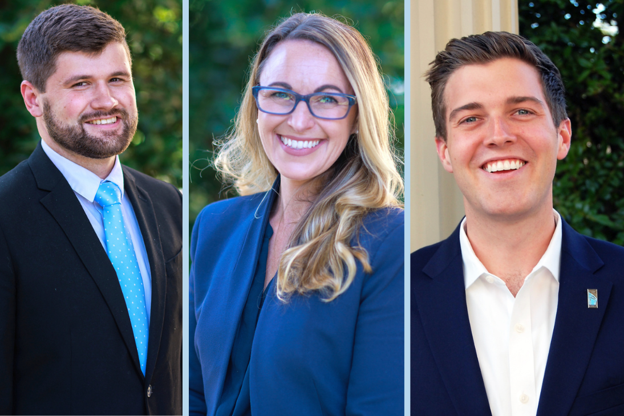
For many, the first day of work brings jitters paired with anxious thoughts. Those of us in higher education may also ask bigger questions: What kind of impact will I have in this role? How can I make the most of this moment? At the School of Government, a place built on public service and civic education, these questions carry particular weight. We caught up with faculty members Colt Jensen, Julie Beasley, and Dylan Russell to hear how they navigated their first year as faculty members and what they learned along the way.
Colt Jensen previously served as a faculty member at Georgia Southern University, where he developed his research on local government management and rural governance.
Julie Beasley's path to a full faculty role at the School of Government began in 2024 when she first joined as an adjunct, drawing on nearly two decades of experience as a human resources and communications practitioner.
For Dylan Russell, the path from student to staff member to faculty truly came full circle. Russell earned his MPA from the School and later joined the staff, where he co-founded and has continued to serve as executive director of Lead for North Carolina. He has been a faculty co-lead since 2019—a role that helped pave the way for his full-time faculty position.
What brought you to the School of Government?
The School of Government is its own entity rooted in service to North Carolina. While it serves the University like any other school within it, there are many things that make it unique. “The School of Government offers a rare combination: practical research, real-world teaching, and direct connection with public officials,” explained Jensen. “I get to hear firsthand about the challenges facing state and local governments, draw on what research already tells us to help those communities, and generate new answers where the research and resources fall short.”
“While most public administration schools focus solely on student impact through undergraduate and graduate programs, our mission also focuses on service to the state.” Julie Beasley cited this when asked about her interest in the school. “This dual mission was particularly compelling, as it allows scholarly research to have direct, measurable impact—findings generated through academic inquiry translate immediately into curriculum for MPA students and practitioners.”
“I first came to the School of Government as an MPA student,” answered Russell. “At that point, I did not know exactly what I wanted to do with my life, but I knew I cared deeply about public institutions and public service. I wanted those commitments to be an anchor for my career.” Russell added, “The MPA program gave me the skills, relationships, and grounding to understand how public institutions work, especially in service to the people and communities of North Carolina.” In our interviews, each faculty member noted that conversations with more tenured colleagues influenced their decision to join the School of Government.
What was the biggest surprise about your first year at the School?
There are many qualities that make this school distinctive, and for new faculty, the full picture only reveals itself over time. Jensen reflected, “The sheer breadth of the School’s work has surprised me most. I knew the School offered a lot of courses and services, but this year showed me just how wide-ranging that work really is.”
Beasley pointed to a similar realization, highlighting the School's ties to communities across the state. “Upon entering my role, I had a foundational understanding of the School's programming and its consulting work with local governments. However, there is a meaningful difference between reading about an organization's impact and witnessing it firsthand.”
Russell reflected on how the school's reputation shaped his experience. "The biggest surprise has been realizing how much the School’s reputation creates opportunities to serve. Being on the faculty at the School of Government has opened doors to conversations I care deeply about: how we attract people to public service, how we support them once they arrive, and how we help public institutions prepare for the future workforce.”
What is one moment this year that stands out to you?
Defining just one moment posed quite a challenge in our conversations. Jensen said, “What stands out is the chance to travel across North Carolina, speak with city councils, and talk directly with managers and staff about the issues they are navigating. Those conversations have been some of the most rewarding parts of my first year.”
Beasley echoed his sentiments, stating, “It is difficult to identify a single defining moment—the experience has been consistently rewarding.” She goes on to focus on the impact of her work: “What has proven most meaningful is witnessing the culmination of student and participant learning and accomplishments on graduation days across the MPA, Civic Fellows, and Advanced Leadership Corps programs. These occasions serve as a powerful reminder of the tangible difference our faculty and staff make in the lives of those we serve.”
For these faculty members, impact is rarely abstract—it presents itself closest to home, in the students they teach and the programs they shape. Russell points to his work within Lead for North Carolina and public service as a whole. “It is hard to pick just one, but the creation of North Carolina’s first Public Service Recognition Week and the Public Service Summit is definitely a highlight. To have Governor Josh Stein, State Auditor Dave Boliek, Raleigh City Manager Marchell Adams-David, and so many other public servants from across the state come together to speak about the importance of public service was incredibly meaningful. The event brought people together around a shared idea: that public service is essential to the future of North Carolina, and that we have to be much more intentional about helping people see themselves in that work.”
What are you most looking forward to next year?
Like life, the world of local government and education is always in motion. There are more chapters to read and be written. Looking forward to new tools for teaching, Jensen shared, “I’m especially looking forward to the release of two books: one in the School’s Board Builder series on council-staff relationships, and the other is an edited volume on intergovernmental relations. I’m excited to use them as practical teaching resources that officials can take back and apply in their own communities.”
Beasley’s focus lies in creating positive impacts within the community and advancing project research. “Looking ahead to the coming year, there is much I hope to accomplish. Leading my priorities is the advancement of several research projects currently underway. The opportunity to see ideas develop into tangible outcomes—collaborating with faculty and MPA students, presenting findings at conferences, and contributing to peer-reviewed publications—is something I anticipate with considerable enthusiasm.”
“Since joining the faculty,” Russell said, “I have had the chance to think about projects beyond Lead for North Carolina, and that has been energizing. I am especially looking forward to working with colleagues across the school on programs that help public officials and public institutions prepare for the future.” Russell continued, "It would also be remiss not to mention the launch of the school’s new undergraduate minor in Law, Government, and Public Service. My entire professional career has been centered on connecting students and young people to public service opportunities. The chance to continue that work alongside exceptional colleagues like Bill Rivenbark, Chuck Szypszak, Jacqui Greene, and Shea Denning is incredibly exciting.” The new undergraduate minor represents another step in the school's commitment to connecting students with public service.
Those early questions—“What kind of impact will I have, how can I make the most of this moment?”—didn’t disappear after the jitters faded. For Jensen, Beasley, and Russell, the first year as faculty at the School of Government has only deepened them. If Dean Aimee Wall's words are any indication, the school is just as fortunate to have found them as they are to have found it.
“These new faculty members bring incredible energy, ideas, and expertise. It can be challenging to find new faculty members who can live and breathe our mission and values. With these hires, I feel as though we truly won the lottery. Our students and public officials will build connections and trust with them as they have with generations of School faculty who have come before.”
For the School, and for North Carolina, the work ahead is just beginning.
Published July 10, 2026.