Assessments in Delinquency Cases: When Can They be Done and Are They Confidential?
Published for On the Civil Side on November 22, 2022.
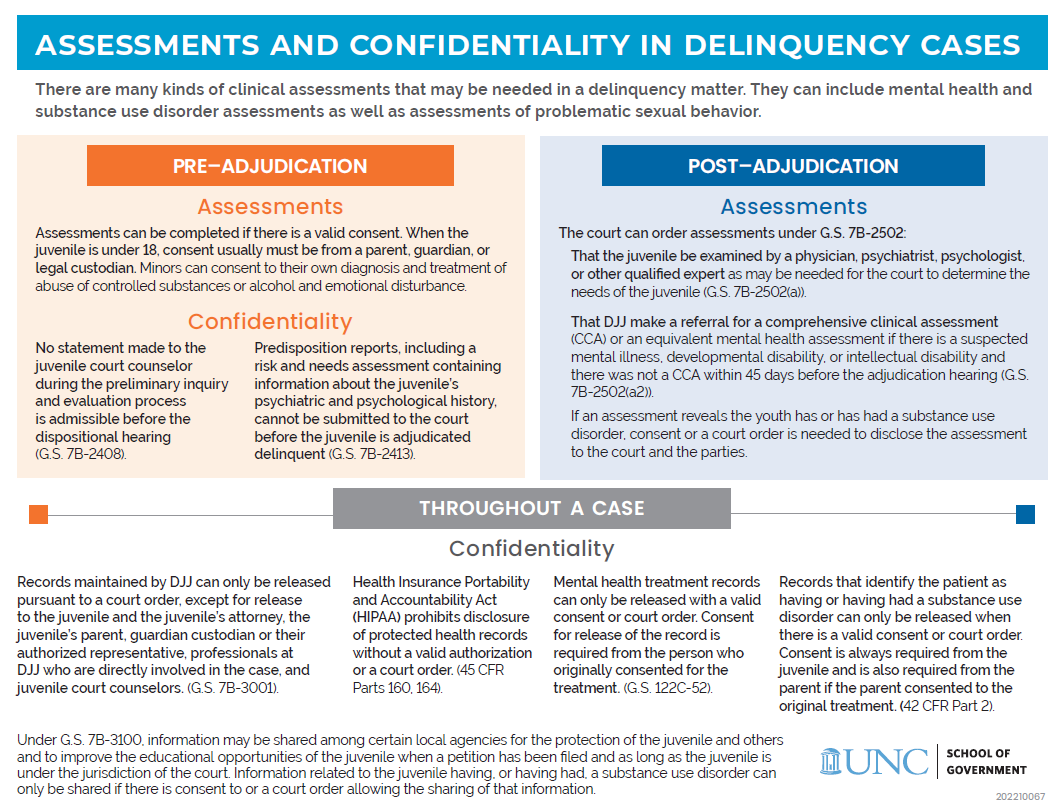
One of the unique features of the juvenile justice system is its statutory focus on identifying the needs of juveniles and resolving matters to provide “appropriate rehabilitative services to juveniles.” G.S. 7B-1500(2)b. In addition to protecting public safety, dispositions should include “an appropriate plan to meet the needs of the juvenile.” G.S. 7B-2500. The caselaw and statutes that govern one form of assessment in delinquency cases—the comprehensive clinical assessment (CCA)—have undergone rapid change in the last few years. Other assessments, such as assessment for problematic sexual behavior or trauma-focused assessments, may also be needed in certain cases. Questions abound regarding when assessments can occur and what confidentiality law applies to them. This new infographic provides a high-level overview of the law that addresses these questions.
When Can Assessments be Completed?
With Consent at Any Time
An assessment can be completed at any time a delinquency matter is pending if there is a valid consent to conduct that assessment. Generally, the parent, guardian, or custodian of the juvenile is the person who must consent. However, minors are permitted to give effective consent for a physician licensed in North Carolina to provide medical health services for the prevention, diagnosis, and treatment of
- venereal disease and any other reportable communicable disease,
- pregnancy,
- abuse of controlled substances or alcohol, and
- emotional disturbance. S. 90-21.5.
- the authority for the court to order an examination by a physician, psychiatrist, psychologist, or other qualified expert to determine the needs of the juvenile (G.S. 7B-2502(a)), and
- a mandate for the court to order the Division of Juvenile Justice to make a referral for a CCA when 1) a juvenile has been adjudicated delinquent, 2) has a suspected mental illness, developmental disability, or intellectual disability, and 3) a CAA or its equivalent was not conducted within the 45 days before the adjudication hearing. G.S. 7B-2502(a2). You can find more detail about this mandate in a previous blog.
- HIPAA prohibits disclosure of protected health records without a valid authorization or a court order. 45 CFR Parts 160, 164.
- Mental health treatment records can only be released with a valid consent or court order. Consent for release of the record is required from the person who originally consented for the treatment. G.S. 122C-52.