
Incapacity to Proceed (G.S. Chapter 15A) and Incompetency (G.S. Chapter 35A): Apples and Oranges?
Published for On the Civil Side on December 13, 2022.
Incapacity to proceed under North Carolina General Statutes (G.S.) Chapter 15A and incompetency proceedings under G.S. Chapter 35A involve, at least in part, a court inquiry into someone’s cognitive abilities. Incapacity to proceed is narrowly focused on a person’s cognition within a criminal legal proceeding. Incompetency is a bigger picture analysis, more broadly focused on the individual’s life and needs, with a bit of forward-looking involved. In that way, incompetency is concerned with both a person’s cognitive abilities and their functioning.
These proceedings are separate and distinct from one another. Yet, if a client has history or present involvement in both, the client’s attorney in one proceeding should know about and understand the other. That attorney may want, for example, to access information or introduce evidence from the other proceeding. The attorney will want to consider issues such as information sharing and confidentiality, and the admissibility or other uses of records from one proceeding in the other.
These issues may be the subject of future posts. First, however, we need to understand incapacity to proceed under G.S. Chapter 15A and incompetency under G.S. Chapter 35A. This post provides a primer on incapacity and incompetency proceedings and compares the standards for each.
 The inquiry at an incapacity hearing. To determine that a defendant is incapable of proceeding, the presiding judge must make two findings. First, the defendant must have a mental illness or defect. G.S. 15A-1001(a). Second, because of this condition, the defendant must be unable to complete any one of the tasks identified in G.S. 15A-1001(a)—meaning they must be unable to either understand the nature and object of the proceedings, to comprehend their own situation in reference to the proceedings, or to reasonably and rationally assist in their defense. The defendant is incapable of proceeding if they are deficient as to any one of the three tests. State v. Shytle, 323 N.C. 684 (1989).
Conditions and behaviors relevant to incapacity. G.S. Chapter 15A does not identify specific mental conditions that may result in incapacity. The existing case law, however, is instructive about such conditions.
The inquiry at an incapacity hearing. To determine that a defendant is incapable of proceeding, the presiding judge must make two findings. First, the defendant must have a mental illness or defect. G.S. 15A-1001(a). Second, because of this condition, the defendant must be unable to complete any one of the tasks identified in G.S. 15A-1001(a)—meaning they must be unable to either understand the nature and object of the proceedings, to comprehend their own situation in reference to the proceedings, or to reasonably and rationally assist in their defense. The defendant is incapable of proceeding if they are deficient as to any one of the three tests. State v. Shytle, 323 N.C. 684 (1989).
Conditions and behaviors relevant to incapacity. G.S. Chapter 15A does not identify specific mental conditions that may result in incapacity. The existing case law, however, is instructive about such conditions.
 The inquiry at an incompetency hearing. An incompetent adult in North Carolina “lacks sufficient capacity to manage the adult’s own affairs or to make or communicate important decisions concerning the adult’s person, family, or property whether the lack of capacity is due to mental illness, intellectual disability, epilepsy, cerebral palsy, autism, inebriety, senility, disease, injury, or similar cause or condition.” G.S. 35A-1101(7).
It is not enough that a person has a condition like the ones identified in G.S. 35A-1101(7). To be incompetent, a person must also lack capacity. A person who has autism, for example, is not per se incompetent. To be adjudicated incompetent, the evidence will need to show that the person is unable to manage their affairs or to make and communicate important decisions.
Managing one’s own affairs. The focus here is on the effect of a person’s decisions—in other words, how well they can run their life. Can the respondent maintain housing, keep medical appointments, or appropriately utilize community services like 911, a grocery store, or a bank?
Making or communicating important decisions. Here, the focus is on the process of decision making, not necessarily whether the decision is a good or bad one. Can the respondent make choices, perhaps considering the pros and cons of each option, and can they communicate those choices to others? If so, the person is competent, even if they make what others would consider to be the wrong choice. See Hagins v. Redevelopment Commission of Greensboro, 275 N.C. 90 (1969) (reasoning that someone who can take care of property, weighing consequences, and exercising rational judgment is competent, regardless of actual performance). To put it plainly, people can make mistakes without being incompetent.
Conditions and behaviors relevant to incompetency. The statutory definition of incompetency identifies some of the conditions that are frequently seen in people who are incompetent, including mental illness, intellectual disability, disease, or injury. G.S. 35A-1101 (7), (8). The list is broad, made broader by the reference to any other “similar cause or condition.” Id. Examples of unspecified but common conditions include:
The inquiry at an incompetency hearing. An incompetent adult in North Carolina “lacks sufficient capacity to manage the adult’s own affairs or to make or communicate important decisions concerning the adult’s person, family, or property whether the lack of capacity is due to mental illness, intellectual disability, epilepsy, cerebral palsy, autism, inebriety, senility, disease, injury, or similar cause or condition.” G.S. 35A-1101(7).
It is not enough that a person has a condition like the ones identified in G.S. 35A-1101(7). To be incompetent, a person must also lack capacity. A person who has autism, for example, is not per se incompetent. To be adjudicated incompetent, the evidence will need to show that the person is unable to manage their affairs or to make and communicate important decisions.
Managing one’s own affairs. The focus here is on the effect of a person’s decisions—in other words, how well they can run their life. Can the respondent maintain housing, keep medical appointments, or appropriately utilize community services like 911, a grocery store, or a bank?
Making or communicating important decisions. Here, the focus is on the process of decision making, not necessarily whether the decision is a good or bad one. Can the respondent make choices, perhaps considering the pros and cons of each option, and can they communicate those choices to others? If so, the person is competent, even if they make what others would consider to be the wrong choice. See Hagins v. Redevelopment Commission of Greensboro, 275 N.C. 90 (1969) (reasoning that someone who can take care of property, weighing consequences, and exercising rational judgment is competent, regardless of actual performance). To put it plainly, people can make mistakes without being incompetent.
Conditions and behaviors relevant to incompetency. The statutory definition of incompetency identifies some of the conditions that are frequently seen in people who are incompetent, including mental illness, intellectual disability, disease, or injury. G.S. 35A-1101 (7), (8). The list is broad, made broader by the reference to any other “similar cause or condition.” Id. Examples of unspecified but common conditions include:
Incapacity to Proceed – A Primer
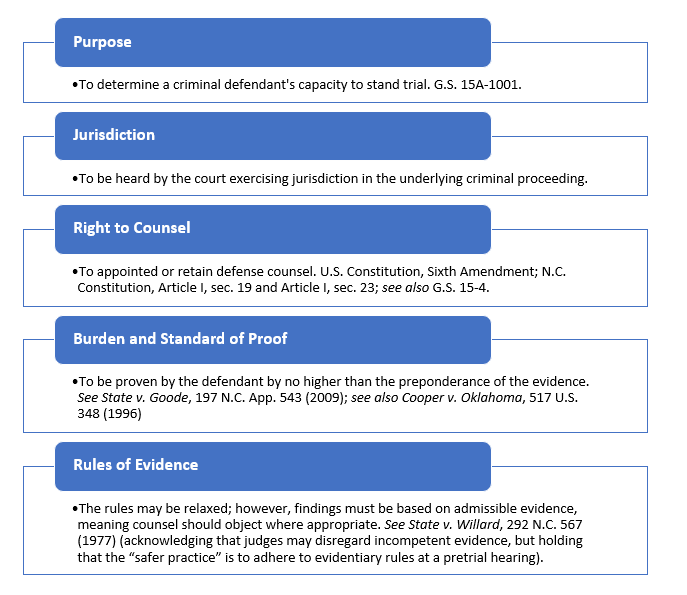
Under the Due Process Clause and North Carolina law, a defendant who is incapable to proceed in a criminal case cannot be tried or punished by the State. See Drope v. Missouri, 420 U.S. 162 (1975); G.S. Chapter 15A, art. 56 Official Commentary. There are three main components to a determination of incapacity: a psychiatric examination, a hearing on capacity, and additional proceedings if a person is found incapable. Below is a bird’s eye view of the second component, the capacity to proceed hearing.
The inquiry at an incapacity hearing. To determine that a defendant is incapable of proceeding, the presiding judge must make two findings. First, the defendant must have a mental illness or defect. G.S. 15A-1001(a). Second, because of this condition, the defendant must be unable to complete any one of the tasks identified in G.S. 15A-1001(a)—meaning they must be unable to either understand the nature and object of the proceedings, to comprehend their own situation in reference to the proceedings, or to reasonably and rationally assist in their defense. The defendant is incapable of proceeding if they are deficient as to any one of the three tests. State v. Shytle, 323 N.C. 684 (1989).
Conditions and behaviors relevant to incapacity. G.S. Chapter 15A does not identify specific mental conditions that may result in incapacity. The existing case law, however, is instructive about such conditions.
- See, e.g., State v. Coley, 193 N.C. App. 458 (2008).
- See, e.g., State v. Willard, 292 N.C. 567 (1977).
- Mental retardation. See e.g., State v. McClain, 169 N.C. App. 657 (2005).
- Posttraumatic Stress Disorder. See, e.g., State v. Avery, 315 N.C. 1 (1985).
- Inappropriate emotional response. See, e.g., State v. Shytle, 323 N.C. 684 (1989).
- paranoia (e.g., unfounded conspiratorial theories),
- poor memory (e.g., inability to recall events),
- unusual emotional responses (e.g., sudden aggression or lack of feeling),
- difficulty communicating (e.g., frequent non sequiturs),
- acting erratically (e.g., obsessive nail biting and pacing), or
- failure to comprehend simple information (e.g., meeting times and places).
Incompetency – A Primer
Under state law, a person in North Carolina who is at least seventeen-and-a-half years-old (or any emancipated minor) who is adjudicated incompetent faces significant consequences, including a loss of rights and the ability to make some decisions. G.S. 35A-1101(7), (8). Known as incompetency proceedings, these are the method by which a person may be adjudicated incompetent—a necessary precursor to the possible appointment of a guardian to act on the person’s behalf. The following is a brief overview of incompetency proceedings under Ch. 35A.
The inquiry at an incompetency hearing. An incompetent adult in North Carolina “lacks sufficient capacity to manage the adult’s own affairs or to make or communicate important decisions concerning the adult’s person, family, or property whether the lack of capacity is due to mental illness, intellectual disability, epilepsy, cerebral palsy, autism, inebriety, senility, disease, injury, or similar cause or condition.” G.S. 35A-1101(7).
It is not enough that a person has a condition like the ones identified in G.S. 35A-1101(7). To be incompetent, a person must also lack capacity. A person who has autism, for example, is not per se incompetent. To be adjudicated incompetent, the evidence will need to show that the person is unable to manage their affairs or to make and communicate important decisions.
Managing one’s own affairs. The focus here is on the effect of a person’s decisions—in other words, how well they can run their life. Can the respondent maintain housing, keep medical appointments, or appropriately utilize community services like 911, a grocery store, or a bank?
Making or communicating important decisions. Here, the focus is on the process of decision making, not necessarily whether the decision is a good or bad one. Can the respondent make choices, perhaps considering the pros and cons of each option, and can they communicate those choices to others? If so, the person is competent, even if they make what others would consider to be the wrong choice. See Hagins v. Redevelopment Commission of Greensboro, 275 N.C. 90 (1969) (reasoning that someone who can take care of property, weighing consequences, and exercising rational judgment is competent, regardless of actual performance). To put it plainly, people can make mistakes without being incompetent.
Conditions and behaviors relevant to incompetency. The statutory definition of incompetency identifies some of the conditions that are frequently seen in people who are incompetent, including mental illness, intellectual disability, disease, or injury. G.S. 35A-1101 (7), (8). The list is broad, made broader by the reference to any other “similar cause or condition.” Id. Examples of unspecified but common conditions include:
- See, e.g., In re Rieger, 269 N.C. App. 474 (2020) (unpublished).
- Posttraumatic Stress Disorder. See, e.g., Leonard v. England, 115 N.C. App. 103 (1994).
- Paranoid delusions. See, e.g., In re Clark, 202 N.C. App. 151 (2010).
- impulsivity or recklessness (e.g., selling one’s only car with no plan for transportation),
- excessive trustworthiness (e.g., allowing strangers into one’s home),
- forgetfulness (e.g., unable to recall taking medication),
- lack of orientation (e.g., to time and place),
- difficulty communicating (e.g., nonresponsive to questions),
- confusion (e.g., regarding petition allegations or living situation), or
- failure to routinely perform tasks of daily life (e.g., cooking meals or maintaining hygiene).
Incapacity and Incompetency: Similarities and Differences
Incapacity to proceed criminally and incompetency share many aspects. Both involve an inquiry in a court proceeding into a person’s cognitive functions. Conditions that impair capacity are relevant to both proceedings, but in neither case is a condition alone determinative. In both proceedings, a person can be capable if they are aided in their functioning by support or intervention. See, e.g., State v. Buie, 297 N.C. 159 (1979) (no error where capacity was the result of medication). For criminal defendants, help may mean a psychiatric stay or medication. For incompetency respondents, help may include access to supportive or adaptive equipment, a stable placement, medication, the involvement of social services or other social supports, or participation in therapy. Despite these similarities, incapacity and incompetency inquiries have different purposes. Capacity hearings are designed to determine whether the person can functionally understand and participate in the specific legal proceeding brought against them. Incompetency hearings require clerks and parties to take a step back and consider the individual’s life beyond the proceeding, including possibly the person’s future needs. The different focus is reflected in the way each issue arises. Incapacity hearings arise only within an existing criminal matter. Incompetency proceedings can be initiated by any person, which, in this context, includes human services agencies and healthcare providers. G.S. 35A-1105.Closing Thoughts
In this post, I explored what incapacity and incompetency each mean. There are other issues that must be considered by an attorney who represents a client involved in both incapacity and incompetency proceedings. Those issues include the confidentiality restrictions that surround each proceeding and the permissible uses of evidence and records from one proceeding in the other. An attorney representing a client in either proceeding will also want to be familiar with any relevant ethical obligations. See, e.g., N.C. Rules of Prof’l Conduct R. 1.14 (representing clients with diminished capacity). Be on the lookout for future posts where I will explore these additional considerations. Reach out to me at Heinle@sog.unc.edu if you would like to discuss the issues raised in this post or if you have experience representing a person involved in both incapacity and incompetency proceedings.Faculty Coordinators

Albert and Gladys Coates Term Professor; Teaching Assistant Professor of Public Law and Government