
Mission Moment: Kirsten Leloudis’s County-by-County Commitment to Public Health
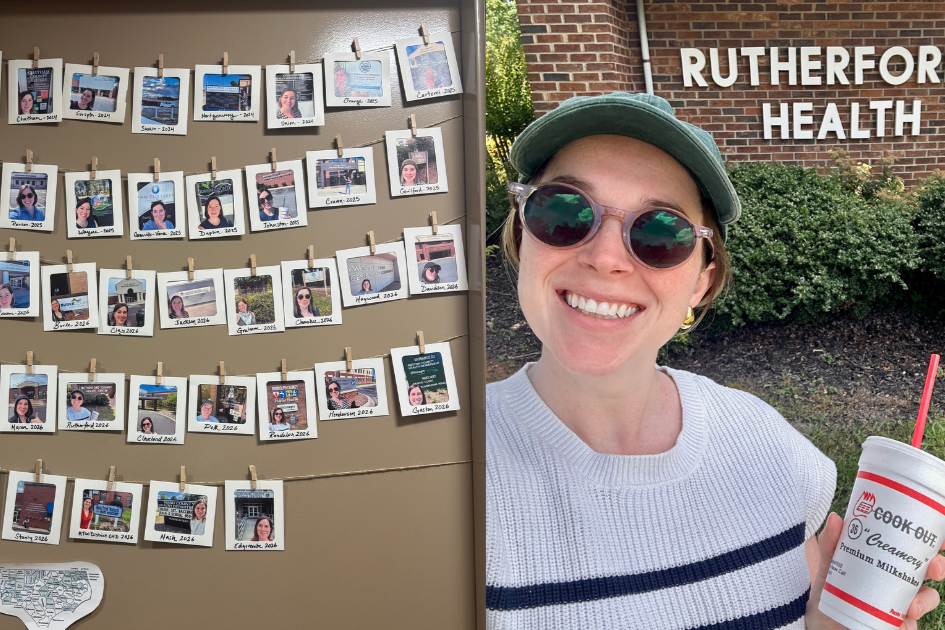
Kirsten Leloudis calls herself a public health nerd. North Carolina has 86 local health departments serving 100 counties, and Leloudis has made it her personal goal to visit them all. At thirty-eight stops on her road to reach them all, it's hard to argue. She documents each visit with a selfie, hanging the photos on the door to her office to track her progress—but there's a rule. “I can only take photos with departments I've actually worked with," Leloudis said. "That means I have to have advised that county, held a program for them, or had their staff in one of my School of Government-based programs.” As a faculty member at the UNC School of Government, Leloudis specializes in public health law and advises the employees of local health departments on the complex legal questions that arise in their day-to-day work. Serving North Carolina's health departments isn't just a professional obligation. It's a commitment she takes literally, one county at a time.
For Leloudis, an Orange County native, the work has always had personal meaning. North Carolina is where she's from as much as where she works, and the relationships she builds across the state reflect that. “It'sjust really lovely to meet people in person. There's a connection that happens that's just different from getting to teach or advise people over Zoom or over the phone,” Leloudis noted. “It’s exciting to put faces and names together. Like ‘oh, you’re the person I spoke with about HIPAA or septic systems for an hour last week!’” Visiting each department in person gives her more information to work with and brings circumstances into focus. “Understanding what types of facilities folks are working with and where they are situated within their communities helps me understand what people are navigating day-to-day,” Leloudis said. “For example, is the health department building on a bus line or do clients need a car to get there? Are health department employees working just across the street from other county departments that they might need to collaborate with, such as animal services or social services, or are they on their own separate campus? Seeing health departments firsthand and learning more about them helps me provide legal information and support that is more practical and useful,” Leloudis said.
What Leloudis remembers most isn't the buildings, but the people within. “Some folks do have a health department in their county that looks like a small-scale hospital. It's large, maybe it's newer. Other folks are working with something that doesn't have a lot of space. It might be harder to get to. The spaces all look really different. What strikes me, though, is that across the board, the people who are inside those spaces doing the work are really dedicated public servants. They work hard, day in and day out, to keep us all safer and healthier, and we are all better off because of them,” Leloudis added. “That’s the common thread across local public health in North Carolina.”
What began as a personal goal has become a tangible measure of the School of Government's reach across North Carolina. The School, and specifically Kirsten Leloudis, works to be responsive to the needs of government officials. Access to legal technical assistance is just one way that Leloudis and other School of Government faculty provide that support. "Public health can be a pretty niche area of law. Every county's health department has access to legal counsel, but those attorneys have to be experts in many different areas and may not routinely encounter questions about, for example, medical confidentiality or communicable disease control measures. That’s where we can sometimes provide additional support. The goal is to share neutral, unbiased legal information so that local health departments can understand what the law requires or allows and then make decisions that are right for their communities,” Leloudis said.
The mission of The School of Government is to improve the lives of North Carolinians by engaging in practical scholarship that helps public officials and citizens understand and improve state and local government. “I take the School's mission to serve every part of North Carolina seriously. I think that's part of what this is about. Am I having fun taking silly selfies all across the state? Yes. But it’s also about visiting and connecting with health departments in every part of North Carolina, and not just the health departments that happen to be a little bit closer to Chapel Hill,” explained Leloudis. “We are here to serve all of North Carolina.”
For Leloudis, carrying out the mission ultimately comes down to trust and relationships. "Getting into the bloodstream, like Albert Coates always encouraged of School of Government faculty, means going out into North Carolina to where the work of local government is being done," Leloudis said. "It's one thing to know the law and theory behind good government. It's another to actually spend time with the individuals who are the boots on the ground, to get to know them a bit and learn more about the people they serve.” Leloudis said. "Those connections help build trust. When people see that your interest in their community and their work is sincere, they’re more likely to reach out the next time they need assistance. And when they do reach out, you learn from them, too. It’s a symbiotic relationship that hopefully helps government work better for all of us.”
_____
This has been a Mission Moment
Since 1931, the School of Government has worked to improve the lives of North Carolinians by helping public officials and citizens understand and improve state and local government. As founder Albert Coates put it, the public officials we serve "strike off sparks already beginning to light up the face of the state like matches struck in the dark."
In 2026, marking our 95th anniversary, we're launching "Mission Moment," a story series spotlighting faculty whose work brings that mission to life—not abstract policy stories, but stories about people showing up, building trust, and making government work better for everyone.
Published August 20, 2026